Morocco street food
Morocco's street food gave me a lot to discover! Whether from a stall, or from someone pushing a hand-cart through the busy medina (market), I was surprised how many tasty things were commonplace there, and new to me. Here are some of my favourites:
- "Kalinti". It's a chickpea-flour-cake as a savoury snack - imagine it as a kind of vegan omelette, because that's pretty much the texture. Many times in northern Morocco we saw this really popular street-food being sold. The kalinti is served in a bread roll (like a short baguette), always accompanied by spread cheese, plus sauces and other toppings such as gherkins or meat. It's a strange combination, I think - the smooshy texture of kalinti with the smooshy texture of spread cheese?! - but it's a hearty snack, and very popular in northern Morocco! A full tin of kalinti, e.g. a round dish about 60 cm diameter, would easily sell out in ten minutes.
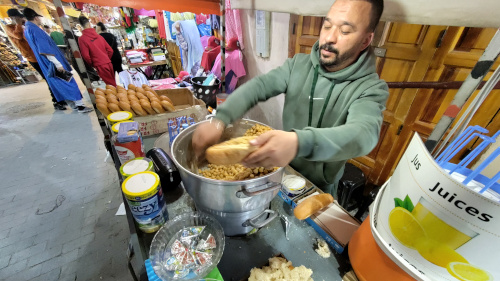
- Chick-peas. At various places in Morocco I saw a seller with a hand-cart, selling cooked chick-peas (presumably fried with a bit of spice). You could buy a simple paper cone of chickpeas to nibble on, or alternatively a sandwich like the above kalinte, i.e. with spread cheese alongside the chickpeas. I didn't see kalinti in Marrakech, but I did see this one.
- Bissara - a simple and hearty split-pea soup. Specialist stalls/shops simply sell this one dish, served with bread and olives. Really good value and a good meal.
And the sweet snacks:
- "Briwate" or "briouate" are samosa-like triangles, and they can be savoury or sweet. Since I avoided the meat, the sweet ones were most interesting, e.g. filled with dates, sultanas and almond paste. My favourite was, I think, a one-off: in Fes, a briouate filled with rice and sweetened with honey/syrup. A delicious hybrid of samosa, rice pudding and caramel flavours!
- There were many pastries, and many pastry stalls stacked SO HIGH with pastries! A favourite that I hadn't seen before was the "gazelle's horn": a crescent-shaped little sweet pasty, stuffed with rich moist almond paste.
Also juices! So many fruit juices! Many stands were simply operated by one person with a pile of fruit and a manual squeezer, which is a good thing to look for since you can guarantee the juice is freshly-squeezed and unadulterated. Some great combos that we had are peach and lemon, avocado and date (with some milk in this one, we think), and sugarcane with lemon. Simply sugarcane, crushed with a bit of added lemon, is surprisingly delicious!
I almost forgot to mention one of my favourite juices: pure pomegranate juice -- multiple times there was a stall which was simply a man with a pile of pomegranates, and a juicer. (OK, also a little tea strainer and some plastic cups.) Pomegranates are expensive, where I come from, because they don't grow where we are - so it's impressive that for an OK price he'll squeeze 3 pomegranates straight into a cup for you. The sweet-sour pomegranate juice is so great on a hot day.
--
And I want to mention a couple of things that aren't street food, but
- Zaalouk - a cold cooked aubergine salad - again a good dish for a hot day. It's really quite simple.
- Msemen - square pancakes, with a flaky bready texture. We already know these back home, but they're very Moroccan. For breakfast we often had these with Moroccan cheese and honey
- Mrouzia - ordinarily this would be a lamb tagine dish, but I had a vegetarian creation at NBTA in Tangiers and it really was my stand-out dish of the entire trip. The taste is sweet and dark, thanks to the honey and prunces, then there's ras el hanout, roasted almonds, and sesame seeds all over. Such delicate and complex flavours, that you don't often get in a fake-meat dish. Fabulous. Go to NBTA in Tangiers.
250 low-alcohol beers, ranked and rated
Just in time for Dry January - we made it to 250! Two hundred and fifty alcohol-free beers, from 20 different countries, ranked and rated, in our delightfully geeky spreadsheet. To celebrate it, in this thread below are some of our absolute favourites:

-
Brulo, a Scottish brewery, makes a fabulous range of beers, almost all of them memorably good - for me, the "dry-hopped stout" is an absolute winner: foamy head, full-bodied stout with a touch of coffee, and a gentle crisp hoppiness. Unbelievably good for a 0.0% dark beer. --- You should also check out their "Sabro Galaxy IPA" which is also delicious.
-
Can Belgian-style beers really be made alcohol free? Surely not, they're so strong! Well not until Force Majeure, a Belgian brewery - thier Tripel really has to be tasted, it's a fabulous achievement. A serious rendition of the Belgian "tripel" style but with no alc. Great frothy head, and a complex, banana-y but not overly sweet flavour, hint of black pepper and very well rounded.
-
No Worries (by Lervig, Norway) - The "No Worries" beers were a revelation when we discovered them - truly Norway's finest. The original "No Worries" is a delicious IPA, and there's plenty I could say about it's great taste and body. But then! There's also a grapefruit version that's delcious and zingy, a pineapple version that's lots of fun. And the excellently-named "No Worries Driving Home For Christmas", a delightful dark (but not heavy) Christmassy ale, with a great foamy head and a lovely balanced taste of cinnamon. You should look out for the funky "No Worries" can design whichever version you find.
-
We have officially drunk 70 alcohol-free IPAs, but there's exactly ONE which comes out on top every single time: Playground IPA, by the Dutch brewery Van de Streek. We've done multiple blindfold taste tests and nothing beats this: a lovely clear IPA taste and mouthfeel, and the balanced but detailed hoppy flavour you want.
-
The best alcohol-free pale ale we've had recently is from the UK's Brewgooder. As soon as we poured this one we could tell it was going to be phenomenal, a pure great pale ale. Smells great, pours great. Then on drinking it’s a really tasty pale ale, with lovely frothy mouthfeel. And it's a true 0.0%! You should try this one, for sure.
-
The UK is also producing some gorgeous alcohol-free IPAs. The breweries you need to know are Brulo, Big Drop and Northern Monk. I really liked Northern Monk's "Super Stredge" - A delightful IPA with a hazy look, a great ringing whack of mosaic dry-hopping, and a mineral finish. Also Big Drop's "Citra 4 hop" pale ale - they've been experimenting with various hop combinations and I think their "4 hop" is perhaps the peak.
-
Want a wheat beer? The Netherlands also has you covered for that. The beer is "Vrijwit" from Brouwerij 't IJ in Amsterdam. It's a delightful Belgiian wheat beer! Frothy head, a complex full flavour, well-balanced and satifsying. If you prefer a German-style wheat, "Maisel's Weisse" is absolutely my favourite.
-
Lowlander (yes, it's Dutch!) is a fabulous brewery that does a lot of sustainable work - they use surplus fruit to make new beers, for example - and they have a lot of interesting alcohol-frees. One you should know is the Lowlander "Cool Earth Lager", which is a delicious hoppy lager, with a mild hint of lemongrass sliding into the aftertaste.
-
I have to tell you about the Polish beer called "For.rest". It's a crazy idea but a great result: the Polish "Nepomucen" brewery decided to use a heck of a lot of spruce pine to replace the "tang" of alcohol - what a great idea! The strong pine - there's more spruce in this than hops - "replaces" the alcohol sharpness brilliantly. Could be fizzer. But honestly it's great, and really memorable.
-
How about something floral? My final Dutch recommendation is this recent discovery of "Bloesem Bluf" which has a delightful flowery flavour (some blossoms in the ingredients?) - slight mango smell, and lavender/violet tastte. Frothy/fizzy mouthfeel and good head - a soft and interesting pale-blonde beer.
When we started this nonsense back in "Dry January" 2019 we had no idea that Europe was going to produce such a burst of really innovative alcohol-free brewing. The only credible beer I was aware of back then was Nanny State. Our spreadsheet officially confirms that there are now at least 147 which are worth your time, scoring 7 or higher! Here's the spreadsheet or as PDF version
My favourite new vegetarian recipes 2023
Hey you! Need lovely food? Me too! So here are our top hit new recipes we discovered in 2023. They're all vegetarian and more than half of them happen to be vegan too. Pick a recipe, try it out:
- Plantain and black bean burgers (PS I only used 100g flour not 250g!) These are a super delicious flavour pairing. also very handy to make ahead and freeze. The flavour combo is fabulous, the black beans help the plantain to taste chunky and meaty - this recipe is so easy, it has no right to taste this good. We used the same flavour combo to make black bean and plantain tacos, which is also great.
- Monastery lentils - very nice way to flavour a simple lentil dish with cheese and sherry!
- "Fresh India" by Meera Sodha -- Honestly, this whole blog article could just be one sentence: "Buy a copy of Fresh India" - because so many of the recipes in that book have been fabulous. There's a mix of traditional and innovative Indian cooking, lots of recipes, well-written and easy to follow. Some recipes from Fresh India that we loved are:
- Baby aubergines stuffed with coconut and peanut
- Blackened sweetcorn chaat
- Paneer butter masala
- Fresh matar paneer
- Mushroom keema
- Potsticker dumplings -- These were nice, easy, and fun. Not very filling though - I put rice with them to make a full meal and I'd still suggest more next time. You could increase the filling by about 30% in my opinion.

- Moroccan Millet & Roasted Carrot Pilaf -- The carrot and the spices go really well with the slightly nutty, and slightly "cakey" texture of the millet grain
- Vegan spaetzle (spätzle, south German noodles) Verdict: #nom. It's a very easy recipe, though a bit of a mess in the kitchen! Handy to be able to whip up these noodles quickly.
- Dutch loaded fries! ("Kapsalon")
- Mushroom/cabbage/tofu ramen, from Tim Anderson's "Vegan JapanEasy". I've never made ramen before this year - it's a bit intimidating, but it was fun and wow it was gorgeous.


- Almond jelly with mango & brown sugar syrup ("annin dōfu"), a delicious n stylish vegan dessert, from Tim Anderson's "Vegan JapanEasy". The almond essence we bought was crazy powerful -- even half a teaspoon for 2 people was still slightly too much!
Most of the recipes I listed here are also vegan. It's getting easier and easier to cook ace vegan food - I used to think it was verging on impossible.
... And here are the top hits from previous years:
Which millet do I have?
In the spirit of the 2023 International Year of Millet, I went to the shop and bought some millet. But what sort of millet?
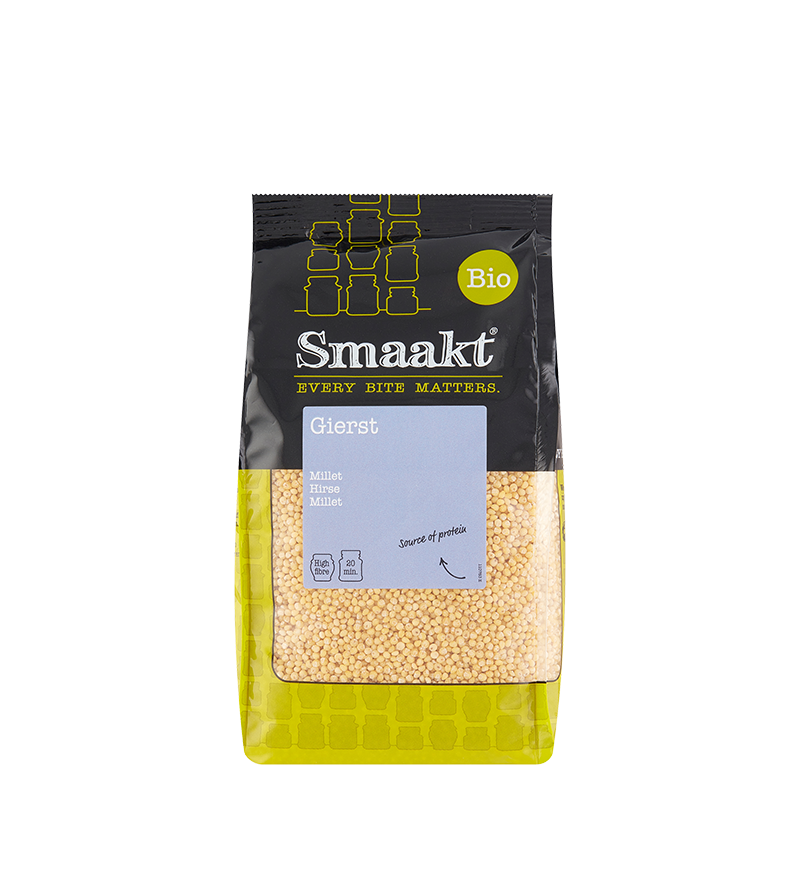
The bag doesn't say at all what it is. Just "millet" (in Dutch, "gierst"). OK, we don't eat much millet in this country, but it's a bit confusing since some recipes ask for a certain type of millet. I wrote to the Dutch shop and asked, and apparently the answer is "Pluimgierst". I'm confused by many different names, so... well here's my list of what I think I've worked out so far, about the main culinary millets that you might possibly find in a shop:
| English | Scientific | Dutch | Notes |
|---|---|---|---|
| Proso millet, feather millet | Panicum miliaceum | Pluimgierst, geelgierst, goudgierst | The Dutch shop says they offer "pluimgierst". Proso is "often used in organic farming systems in Europe" and common in USA too? |
| Foxtail millet, Italian millet, panic | Setaria italica, Panicum italicum | Trosgierst | Most common Asian millet (in India since antiquity), and 2nd most common worldwide |
| Pearl millet | Cenchrus americanus, Pennisetum glaucum | Parelgierst | Most common worldwide (in Africa+India since antiquity) |
| Finger millet | Eleusine coracana | Vingergierst | Known as kelvaragu (or ragi) in India, and kurakkan in Sri Lanka. Originated in East Africa. |
| Kodo millet | Paspalum scrobiculatum | ? | Although Wikipedia for Finger millet mentions "kodo" to mean millet-flour in Nepal, the "kodo millet" page says "not to be confused with finger millet"! Kodo millet is grown/used in Nepal and India. |
Is this table correct? I don't know! Please do correct me if you see a mistake. I might try to update Wikipedia with these cross-language comparisons later - it's got some of them, but it doesn't have a standalong article for each of these so it's not necessarily the place to find the info.
UPDATE: This article by an American academic is informative, and has a detailed table
Great food in Ljubljana
I was really excited by the vegetarian food scene in Ljubljana, Slovenia - it's way more interesting than most other cities I've been so far. That's because there's lots to try, with modern vegan/vegetarian stuff going on, BUT ALSO there's lots of local flavour and regional cuisine mixed in there. I had a lot of things I've not tried before. And lots was great!
Let's start with a bit of fine dining. We didn't have time go to "Gaudi & Naan", a well-established posh veggie restaurant, but we went to Bistro Maha which is a small place that's recently started s 3-couse evening meal service. This is what we ate:
- Starters:
- Witloof (chicory) with king oyster mushroom, a cream sauce, and a fantastic "caviar" (made from what?! not sure)
- Pea and asparagus sponge, with strawberry
- Main course: Lionsmane "steaks", with dauphinoise potatoes, a fruity red wine sauce, and crispy leeks
- Dessert: Fermented soy cheesecake with strawberry coulis

Everything was fabulously flavoured, and we chatted to the host about the food. Coming from the Netherlands it was interesting to try a fancy version of witloof.
Next, let's move on to the street-food: on the weekly street-food market there were a couple of local veggies. There's a Slovenian fake-meat company called "Amaze", whose Amaze-burgers were... yeah pretty amazing. A different stall on the same market sells "štruklji", the spiral-rolled wheat dumpling that's everywhere in this region. THe most common is savoury, a cheese štruklji. I had the buckwheat and walnut štrukjli as my afters, since it looked the most different, and it was lovely. Buckwheat is common round here too, so I'm told.

Abi Falafel is a falafel-and-more place that's very popular, cheap, and flipping delicious. Our falafel and our dolma were great.
Another place that can definitely give you lots of regional specialities (in veggie form) is Gujžina. They specialise in a big menu of dishes from the North-East of Slovenia. It was super interesting - not perfect, I must say, a bit bland. But they have a variety of different regional sausages. I had lionsmane "liver-style" served with turnip and millet. Plenty to try.
The tourist adverts will tell you to try "kremšnita". A fancy dessert/pastry, with a protected name. Hilariously, though, it's exactly the same as the "vanilla slice"/"custard slice" that I grew up with in Britain, or also the "tompouce" popular in the Netherlands. The idea of taking an intercontinental train to seek out the custard slice is kinda funny. ... It tastes good, though, all the same.
Strudel is another widespread pastry. Here in Ljubljana we had a couple of great ones: cherry (lots of cherries grown there!), and a really tasty savoury one, asparagus and cheese strudel. Speaking of cheese, up in the hills (Velika Planina) we also sampled a more traditional cheese: a hand-churned raw cheese which we bought direct from a cowherd.
Oh and I almost forgot coffee. A fabulous density of really tasty modern coffee houses. You should drink at ALL these coffee shops: Črno Zrno, Mala Pražarna, Čockl, Kavarna Moderna, Stow. I've had great coffee in London, Glasgow, Berlin, and more, but here in Ljubljana I was bowled over by how many of the coffees were really delicious. Great filter coffee, cold brew, espresso.

One thing new to us was the "espresso tonic", though since we came back home, it seems this drink is cropping up everywhere in summer. We first encountered it as espresso mixed with tonic water, ice, and grapefruit juice. What? Well I drank it. I thought it was merely weird, a "dirty fruit juice" of some weird sort. Much tastier in my opinion was "cascara" - again new to me but apparently that's a Spanish word for a tea (tisane) made from coffee berries. The overall effect is a dark iced-tea-like drink reminscent of berry fruit and coffee, very refreshing.
Every country has a "stupid chips meal"
I'm gradually discovering that every culture has its own "stupid chips meal". (Note to Americans: he's British, he's referring to fries.)
In the UK we love a chip butty (chips in bread), and we struggle to justify it. But there are many other hard-to-justify dishes hiding out there. So far I've got this list, which looks to me like a pattern:
- UK: chip butty. Chips in bread. Chip sandwich. Chips in pitta. A bit basic.
- CA: poutine. A rather famous dish of chips and cheese curds topped with gravy.
- NL: kapsalon. Invented in 2003 (?) by a Dutch barber (?), it's now famous in the country: chips topped with salad, cheese, meat and sauce.
- BE: mitraillette. A chip butty with meat and sauce.
- FR: tacos français. It's hard to believe that the French could achieve possibly the stupidest version. This one manages to also trample all over the noble tex-mex lineage of the taco. The French "tacos" (spelt with an "s" even in the singular -- see how trashy?) is apparently a flour tortilla, but stuffed with chips, cheese, meat, and more. It's not at all reminiscent of a taco, just a cheap chips wrap. ... Oh and -- it's not even good.
- PT: ovos rotos. "Messy eggs" or "broken eggs" -- chips topped with fried eggs, ham (probably) and a mess of other stuff.
- IE: spice bag, allegedly invented in 2008 in a Dublin Chinese restaurant, and involving chips, peppers, chillies, chicken, & fried onions?
- ZA: kota, a hollowed-out bread stuffed with chips, meat (often sausage), cheese, mango pickle. (This one has an interesting history - see the link - apparently as an equivalent of the Cornish pasty, a portable lunch for miners.)
An emergent phenomenon. Chips with some or all of bread, cheese, meat, gravy, i.e. some protein and some sauce. Unhealthy, un-refined, un-pretty.
How far does this continue?
How to cook with millet
Did you know 2023 is the international year of MILLET? No??? Well don't worry, no-one seems to know about it, though it was decreed by the UN.
The BBC has a nice article about traditional millet in India. But neither the UN nor the BBC seems to be willing to …
Secret weapons in the vegan store-cupboard (& cheap!)
Recently I've been learning more and more how to cook vegan. It seems hard at first to be totally plant-based, for sure. There are some super cheap ingredients which I had no idea were so useful! So here are my absolute top tips, things to put in your store cupboard …
Favourite vegetarian recipes of 2021
We've discovered some lovely vegetarian recipes this year! The lockdown last year was actually a pretty good opportunity to get better at cooking, especially when we had to dig into our stockpile - yes, it really got to that point, strange to think now. This year was a bit less extreme …
Dutch alcohol-free beer - 2021 update
After some in-depth field research, I'm ready to report that the Netherlands alcohol-free beer scene has boomed in the last couple of years. We've now tasted 24 of them! And 7 of them are great.
Van de Streek's "Playground IPA" has been around for a while now and is in …