My academic travel carbon footprint: Trains versus planes
I've been doing a lot of academic travel recently: conferences, project meetings, workshops, PhD exams. Luckily, I've been able to do almost all of it by train, even though I've been to more countries than I can easily count!
Here I want to list these and make an approximate carbon footprint calculation, comparing it against the equivalent if I was flying everywhere. I've done these calculations before, but since I've made dozens of trips recently it's useful to show it and give a real-life example of what we do and to what extent it matters.
So! Here is a list of the academic travel I did in 2024 and 2025, with the reason for travelling, and the carbon footprint if I was flying. Then, I will compare those footprints against those for what I actually did. In most cases I took the train. Sometimes a boat (especially for the UK). For two of these I did fly part of the way, and I'll mention that in the table.
I live in the Netherlands. I'm going to leave out the trips to the Netherlands and Belgium, because it's simply inconceivable that someone would fly those! I will also omit the events I declined or attended online.
In this table, the numbers are the hypothetical footprint of flights I did not take:
| Date | City | Country | Event | kg CO2e if flying |
|---|---|---|---|---|
| 2024-01 | Oxford | UK | PhD viva | 307 |
| 2024-02 | Trondheim | NO | Project kickoff meting | 316* |
| 2024-03 | Zurich | CH | Invited seminar | 403 |
| 2024-05 | Prague/Kostelec | CZ | Project 1-week workshop | 438 |
| 2024-06 | Chemnitz | DE | Academic conference | 414 |
| 2024-08 | Lyon | FR | Academic conference | 446 |
| 2024-09 | Barcelona | ES | Project annual meeting | 615 |
| 2024-12 | Konstanz | DE | Project 1-week workshop | 403 |
| 2025-04 | Zurich | CH | Academic conference (invited speaker) | 403 |
| 2025-05 | Lund-Gothenburg-Tampere | SE/FI | Academic conference, plus project workshop | 1277* |
| 2025-08 | London | UK | PhD viva | 307 |
| 2025-09 | Odense | DK | Academic conference | 372 |
| 2025-10 | London | UK | PhD viva | 307 |
| 2025-10 | Barcelona | ES | Academic conference | 615 |
| 2025-11 | Paris | FR | Project 1-week workshop | 336 |
Now, in most cases what I actually did was take the train. Using a carbon-footprint calculator I worked out the footprint for these, and surprisingly, it often comes out as approximately 10 kg CO2e, irrespective of how long the trip is! This is because of the different types of train: to go all the way to Sweden I took very efficient ICEs, while to go to Oxford I took a local train, plus a Eurostar, plus another local train, and it appears to add up to a similar amount. So, for simplicity I'm going to assume each train trip was 10kg. Since it's at least ten times smaller than the flight footprint, this approximation is acceptable.
The two trips I've marked with asterisks* are the ones where I part-flew. Even if you can't take the train all the way, it's better than taking lots of hopping flights. Here's what I did:
- For Norway in 2024, I flew to Oslo and then took the train to Trondheim. It would have been 316kg to fly direct (and even more to fly indirect!), but I managed at least to reduce this one to 264kg by taking the beautiful Oslo-Trondheim train ride.
- For Finland in 2025 - it takes a long time by train from the Netherlands, of course! I was able to make the most of it by combining a conference in Sweden with the event in Finland. So this is a "triangular" two-stop trip and that's how I've calculated it. I flew back on the return, meaning my actual footprint was around 720kg rather than the max of 1277kg.
If you add up all those hypothetical flights in the table above -- and, just to remind you, those are flights I did NOT take -- you get 6959kg over 2 years, about half of an average EU citizen's "personal" footprint for the same time. So it's a notable amount. What I actually incurred was 1104kg, reducing it to about 15%.
It's a definite saving. Of course it's way above zero, it's an amount worth thinking about. (I won't comment here on switching to online attendance - I've written about that before and it would take too many words.) Note that this is not only an estimate, it's also an incomplete picture: not least because it ignores online events, and local events. I mainly want to see what was the impact of my choice not to fly on these business trips.
I think it's important to remember that we're aiming to change the system, we're not aiming to guilt-trip individuals. So the wider lesson is that grounded academic travel is possible, it makes a genuine difference -- approximately an order of magnitude reduction! -- and we need to support it (in the departments, in funding, and when you organise a conference).
This post was partly inspired by Rebecca Nordquist's post describing similar experiences. As noted by Rebecca, these long train trips are often also your "best day in the office" for some quiet work!
Air travel is a pain in the bum (but we don't notice)
The idea that rail travel is "difficult" is hilarious when you compare it with eyes open against plane travel. I avoid flying if I can, and I've had fabulous trips to many countries by train and boat. Some friends say "Sounds great, but I couldn't manage it from where I live. And with the kids too!" - I think they've blinded themselves to how much flying is a pain in the bum.
I had to go by plane recently, for urgent reasons. It's complex, weird and alienating, and there are lots of strange processes which are definitely more complex than a train timetable.
I was really surprised to notice how much walking is involved. Recently, we were at Munich train station. It's a big train station, and we said to ourselves, "Gosh, it takes about 10 minutes to get from our arrival to our other platform" -- but then while taking a flight recently I had to walk inside the airport for twenty minutes. At BOTH ends. Twenty minutes is not an exaggeration: I timed it. (I used the travelators. I had no baggage to collect. So this is a very optimistic version of how long it takes.) So, forty minutes of walking added on to the journey time, which is hidden away, pretended not to exist. It's hidden inside the "airport" ritual so we don't think of it as a separate task.
I notice the weirdness of plane travel in the phenomenon of these hard, wheely, rectangular suitcases that are now ubiquitous. They're useless for almost everything - walking around a city, for example - and they're much heavier and less adaptable than soft-cased luggage. But they're specifically tailored for airline cabin baggage size restrictions, and designed to be robust against throwing around on a luggage conveyor, and so lots of people buy this baggage, condemning themselves to be awkward in all situations except the airport.
In my normal travels I don't need to worry exactly what size or shape my bag is - I just bring as much or as little as I need.
I notice more weirdness when I go through airport security, of course. Unless you're a frequent flyer there's no way to keep track of the varying security requirements: on my recent flight "shoes off" and "laptops out" were not required, but "belt off" was -- and I've no idea why. In one direction, I had to show them my tootpaste tube. In the other direction I didn't. The absolutely yucky experience of those body-scanners is another horrid part of it.
The "overbooking" phenomenon is yet another bizarre aspect, which I think regular users take for granted... Sitting in the boarding lounge for the flight I've booked, with a seat number printed right there on my boarding card, I hear regular announcements "This flight is overbooked - if you're willing to take the next flight, for a cash reward, contact the desk." Clearly it's dumb for the airlines to deliberately overbook their flights: they do it to squeeze the maximum profit out, inconveniencing us with a mild dishonesty while pretending they aren't doing. Does someone else also have a boarding card with my seat number written on it? Wouldn't that be weird? What if no-one volunteers?
I don't need to say much about the strange upselling tricks they use during the sales process, pretty much a cliche. One airline wanted to trick me into paying extra to choose a seat; one wanted to trick me into paying extra for baggage. These "dark patterns" are well-known to people who do this, but gee it makes the whole thing complex to work out.
How is it that people put themselves and their kids through this weird business, and why don't they say "I'd like to fly for a holiday, but I couldn't manage it with the kids"? It's what you're used to, I'm sure. There's also a lot of commercial interest in it, as you can tell if you walk around the airport terminal surrounded by strange perfume adverts, trying to find a drink that is NOT a beer from the official sponsor's brand.
It's funny to compare this against my experience of train travel. There are some definite tricky parts e.g. how much of a gap to leave to make sure you don't miss your connection? (If you're changing trains in Germany, leave 30 minutes gap in case of the almost-inevitable ten-minute delay...) But the process is so free, and so NORMAL. You don't need weird luggage, or bizarre procedures. It's almost the same effort to get on a train across Europe, as to get on a bus to go down into town!
BSc taught course "AI for Nature and Environment"
This year at Tilburg University I launched my new undergraduate course: "AI for Nature and Environment". After a few different conversations I was encouraged to put some information online about it, so here's an overview of the whole thing.
First let me address one thing: "AI for Nature and Environment"? Really? Does nature really need more AI? ... Well in a way, no. AI is not the solution. Land management, good politics, quitting oil, and quitting beef -- they're all much more important. However, AI and modern data technologies are crucial to effective management of almost all the good solutions, even "nature-based solutions".
My course is intended for everyone out there who has developed some skills with data science and machine learning, and wants to use them for good. For example, if you're thinking about how you can move into a new career in which those skills are actually helping with some of the world's biggest problems: climate and biodiversity.
Here are all the details, corresponding to the 2023 edition at least:
Target level: BSc 3rd year (BSc Cognitive Science and AI)
Instruction language: English
Aims:
This course will provide the skills and knowledge to apply AI and data science in multiple ways to help nature and the environment. The biodiversity crisis and climate crisis are complex and interconnected: luckily there are many ways that technology can help to monitor the natural world, and to help society have a more positive impact. After successful completion of this course, students will be able to:
- Explain multiple current/novel ways in which AI can be used for biodiversity/ecology/environment.
- Critically evaluate potential data-driven interventions in natural environments, for their benefits and impacts.
- Describe good practice and common pitfalls in machine learning and data processing, within the realm of biodiversity/ecology/environmental data.
- Implement algorithmic data analysis for biodiversity/ecology/environment in Python.
- Analyse the performance of AI algorithms on datasets relating to the natural world.
Content:
This course focusses on a diverse set of applications of tech for nature, in each case studying how data science and AI methodologies can be used. We also encourage a critical and comparative approach, by looking at the impacts as well as the benefits of tech for nature, and considering machine learning good practices. The course assumes some familiarity with programming (Python) and with AI concepts, and explores the topics through computer-based data/AI practical work.
Topics covered include:
- Computer vision for wildlife monitoring
- Acoustic monitoring (bioacoustics): AI sound detection and classification
- Deep learning methods and their relation to wildlife data
- Remote sensing (e.g. satellite, drone)
- Citizen science
- Devices for AI monitoring in the wild
- Estimating animal populations
- Critiques of some technologies; benefits/impacts on nature
- Advanced topics in bioacoustics and deep learning
Prerequisites:
- Experience in python programming
- Knowledge of machine learning, e.g. through CSAI courses on ML/DL
Assessment:
(a) 60% final exam
(b) 30% individual coding project
(c) 10% group "paper review" presentation
Lecture topics:
- Intro: biodiversity, climate, data science, AI
- Deep learning for images of wildlife
- Seeing from above: Remote sensing
- Deep learning for audio
- Citizen science
- Electricity generation/grids. And: Cost-benefit & critiques
- Devices in the wild
--mid-term-- - Tracking movement: Biologging
- Data mining, large-scale, data-viz
- Bad tech
- Estimating animal populations
- Advanced topics 1
- Advanced topics 2
- Synaptic, exam, Q&A
Recommended reading:
- "Perspectives in machine learning for wildlife conservation", Tuia et al. 2022.
- "Emerging technologies revolutionise insect ecology and monitoring", van Klink et al. 2022.
- "Computational bioacoustics with deep learning: a review and roadmap", Stowell 2022.
- "Tackling Climate Change with Machine Learning", Rolnick et al 2019.
Online communities:
I highly recommend both Climate Change AI and WildLabs which organise online events, courses, links to interesting stuff, and more.
Notes on "Staying with the trouble: making kin in the Chthulucene" by Donna Haraway
Since I'm thinking about ecology, philosophy, and multi-species coexistence, it was about time I read "Staying with the trouble: making kin in the Chthulucene" by Donna Haraway. The book reflects a very wise approach to multi-species coexistence.
I found the overall message a good one -- but weirdly, to digest the overall message all I really needed was the title and the introductory chapter, which unpacks the delicately-constructed title and explains the slogans. Once I read the intro, I had already learnt pretty much everything I was going to get out of this book. The rest is repetition and elaboration of the themes.
Partly this is because the writing style is very unusual, and anyone approaching it should beware that they'll need to be patient with all the wordplay, meta-textuality and constructive ambiguity. The book is philosophy, yes. In some ways it helps to read it as poetry: the lessons you take from it are largely through allusion and metaphor. So you could instead describe it as non-fiction poetry.
I do understand Haraway's meta-textual point, that it matters HOW you think and construct ideas, and this is exactly why she chooses a "tentacular" way of building up the narrative points. There's real value there. For me it's approach contrasts neatly against Bruno Latour's "Down to Earth" which I read recently: Latour tries to construct a simple conceptual framework for ecological thinking, and the book is good, but he doesn't quite manage to convey his ideas clearly or crisply enough (due to the lack of a strict editor, in my opinion). On the contrary, Haraway's writing is very un-simplified, full of poetics, wordplay and repetition, but in part that's the point. The way it's written deliberately embodies the tangled "hot mess of compost" future that she advocates.
Chapter 2 however does contain additional clear detail: it's very clear on why "anthropocene" is a poor choice of term for our current era, and "capitalocene" is better; and then further why that term is wrong too, and the story to be told is "chthulucene".
Chapter 3 introduces some science-art projects, but not really working hard to persuade us that "science art" is of any real benefit for living our lives, beyond asserting that they are tentacular practices. The projects in this chapter feel rather small to me, and it's not clear what I learn from them. I love science art and have witnessed (and done) plenty of it, but I don't see what in particular it has to do with the Chthulucene. --- Almost anything can be described in tentacular form, i.e. weaving multiple distant connections together. The Black Mesa example is the strongest one in the chapter. But still... thus, what?
Some page-wise notes:
p4 Despair [e.g. climate nihilism] caused by the falsehood that "only if things work do they matter". A beautiful point.
p40-41 Intriguing praise & explication of Latour's position on the "earthbound".
p42-43 Criticising Latour's previous stories of strength, struggle and war in ecology. Latour must have read this before writing "Down to Earth"! That's why DtE seems such a pacifist text, and, as I noticed, can't seem to tell us how to resist the violence against us.
p43-44 Discussing Gaia in Latour and in others' works.
p105 nice philosopher's definition of "queer": "Not committed to reproduction of kind" (and also "having bumptious relations with futurities")
p165 The concept of "animism" seems to be thrown around casually here, and without unpacking it. Is it really a good thing to advocate? Animist beliefs could range from a simple appreciation of the tentacular (?!) to a literal spiritual animism as practised in some religions, and surely that's not baggage that Haraway really wants us to pick up?
--- I find out later online that there's a rather post-modern meaning of "animism" popularised in anthropology by Latour. I would have to read even more to be sure what baggage is really hanging on that word. It seems Latourian animism has something to do with rejecting the dualism where only humans can be the cause/instigator while "mere objects" cannot. The "animism" that rejects this dualism fits well with Haraway's multi-species and tentacular position.
In what I've read online, Latour seems to pitch "animism" as a rejection of "modern" dualistic thinking. But I see it differently: it seems to me that perfectly ordinary modern thinking (of the non-spiritual non-Cartesian type exemplified e.g. by many physicists) puts humans on the same level as everything else, with no special causal or "agent" role. To my mind, if "animism" has any meaning it is something that rejects this, it's something that asserts that causal chains can terminate in all kinds of things which we'd then think of as having "agency". In ordinary modern thought, there are no ends to the causal chains: causation circulates endlessly. And ... the latter seems to me more faithful to Haraway-style thinking of Chthulucenic sympoeisis!
Politics in the new climate regime: a review of Latour 2013
I'm re-reading "Down to Earth" by Bruno Latour (2013). I recommend it: it's a short, accessible, imperfect but thought-provoking piece of climate philosophy. It's only around 100 pages yet it offers some tools for thought, for anyone wondering about the fundamentals of how we can achieve a sustainable society.
And also I'd like its cover art as a T-shirt please.
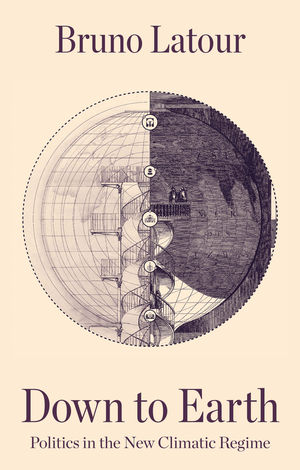
I do find it a valuable but imperfect book. Since I grew up obsessed with pure physics and I now work in ecology, I find really strong support in his frame of thought that de-thrones (astro)physics as the root of all science, and creates a new framework centred on interaction in the Critical Zone (i.e. the troposphere etc) -- in other words, scientific ecology is the fundamental science. He doesn't call it scientific ecology, he describes in various words the study he's hoping for (p93), yet it seems to be exactly that except a little more politically-engaged.
The diagrammatic thinking he uses is a memorable and useful way to argue for a new frame different from the "local-versus-global". It stayed with me from my first reading years ago. There's some confusion in his concepts of "globalisation-plus" and "globalisation-minus" -- although they are key concepts, he omits to define them precisely and so the reader gets a bit stuck (p13 onwards) trying to clarify which terms he's using for which ideas. It does get clarified later (p26? p30?). But it seems to me that Latour, as an eminent senior thinker, suffered here from not having a strict editor.
But then, the book really takes flight, especially in the second half. It ends with a sweet, sweet ode to Europe, which he includes as part of his own contribution to the project of self-description that he says we need. This ode is really beautiful, and touching for a European to read.
Some page-wise notes:
p2 He introduces the (correct) notion that, since the 1980s, the super-rich have decided to conspire against us all, and steal the Earth for themselves. ... and then he writes that what we need is a "map" of "where to land" ... not that we need a fucking revolution?? Why so tame? His readers are not the ones who need to be convinced of the "need to land"! --- How can I "look for a place to land" if powerful forces are determined to steal it from me?
p7 His strong analogy between the victims of empire/landgrabs/globalisation, and our own anxiety at being evicted from a stable future, is indeed a bit tasteless. But nonetheless I must admit it strikes a chord for me.
p46 Ecology has "succeeded" in changing politics "by introducing objects that had not previously belonged to" politics, but also failed because it's so often a marginalised party, and often placed in opposition to "economics" etc, the opposing needs then given greater salience. -- This is the core concern that comes back in his 2023 co-authored booklet: ecology is really about everything, not a fringe interest -- it encompasses economic concerns etc -- so how can we turn that truth into a political reality?
p73 "Nature" is too remote (distant), and also a catch-all term that loses meaning, so don't organise protest around that. --- Fair point he makes. But what "big idea" DOESN'T succumb to that? ... Well, it occurs to me that Extinction Rebellion's ideas are a good example, their very concrete demands (tell the truth, organise citizen's assemblies, etc). Latour expands and fills in his idea of "the terrestrial" in the second half of the book, and I think this is a valuable/handy concept indeed. Is it really robust against this distancing?
Latour then discusses a rather Lovelockian cybernetics of agents. It's not really clear to me why he distances his framing from Lovelock: earlier in the book he mentions Gaia but then unhelpfully remarks it would take too many paragraphs to state why that's not the right concept to work with (!). Here he specifically proposes limiting attention to the Earth's "Critical Zone", and this is essentially how (astro)physics gets dethroned. I think it's a good and clear proposition. Biologists know more than physicists about the critical zone; their knowledge is not provincial.
P.S. This LRB article by Jeremy Harding is a great overview of Latour's environmental thinking, and in particular what's good and what's vague about it.
The biggest solar farms - who loves them and who hates them?
Solar farms are getting bigger!
Back in 2016, the biggest solar farm in the Netherlands opened with a much-heralded power capacity of 6 megawatts - "enough electricity to supply all 1,700 households on the island". Fast forward to December 2019 and the biggest Dutch solar farm is now 103 megawatts, near Groningen in the north of the country. More than fifteen times the capacity! In fact it's more than the entire country's solar capacity in 2010.

It's bigger than anything in the UK, where one of the largest is this 70 MW farm, notably arranged around a former military runway (see picture). But just last month the UK Government approved plans for Cleve Hill Solar Farm, on the coast in Kent (South-East England): a phenomenal size, 350 megawatts, supplying enough power for up to 91,000 homes. On a sunny day, that could power the nearby town of Faversham a few times over.
Every country needs solar farms such as these. Of course, they're just one part of the energy supply, but an important part, and a growth industry too. A solar farm as big as a village is not just a news item, it's a crucial part of the world we want to build. An important question then is: What does the actual village, next door, think of the solar farm? What's their relationship with it - do they get to be involved in the planning of it? Or even, do they get to have some say in the running of it? After all, these things don't land from space - just like a local factory or a local farm, they're a part of our community fabric.
There's a "standard" way for communities to get involved. In the UK and the NL, solar farms need local planning permission to build, which is usually decided by local councils. They take account of objections or specific local considerations. And - partly driven by this - most companies carry out public consultations as part of their planning. You might also get protests of course. Sometimes there's even a local celebrity involved in the protest.
That's why it can be newsworthy when something gets approved with zero objections. That's what happened at the large (125 MW) Dorhout Mees solar farm near the Dutch village of Biddinghuizen. Bigger than anything currently in the UK or Netherlands. So how did they do it? Were local people attracted by the fact that they're putting it in an exercise park, with a running track looping through the solar panels? You have to admit, that's kind of intriguing - imagine going for a jog through this:

(Here's another eyecatching feature I like, from a different solar project: Vlagtwedde, is planting a 24-hectare blueberry farm as part of their solar farm development. Not just jobs - you also get blueberries!)
The big English project that we mentioned above (Cleve Hill) has been the subject of some protest and debate. (The planning documents are here.) There has been a local campaign against it, and concerns expressed by Greenpeace, RSPB and others about the effect on wildlife habitats. Remember that there's not just a climate crisis going on: there's also a biodiversity crisis. On the other hand, Friends of the Earth were broadly in favour of it. Their spokesperson Mike Childs pointed out that it makes a difference what's currently there at the site:
"No-one wants to see damage to local habitats, but this is not some lovely, untouched meadow.
"Changing the use of the site from intensive agriculture will reduce the high level of chemicals currently harming insects and wildlife - but we have to hold the developers to account."
The developers took account of concerns from these organisations and from locals. Indeed they had to, to get approved. The approved plan includes "56 hectares of specially managed habitat being set aside for overwintering birds, which has been designed in consultation with RSPB, Natural England and Kent Wildlife Trust". This area for protecting wildlife wasn't in the original plan: in the same spot, there were more solar panels. So at the cost of slightly less power production, the site now takes more care of the biodiversity in the region.
But there's a different way to do community. Rather than getting local opinion on board as an add-on, or to tweak an existing plan, what if solar farms were created by local communities themselves? Lots of us want to get involved in the renewable energy transition, and we all have good knowledge of our local areas. Why not?
The English village of Balcombe is an amazing story of this. They first hit the headlines as a village protesting against a company that wanted to set up fracking nearby. ("Fracking", or hydraulic fracturing, is a way of extracting fossil fuel from the ground, controversial for a few reasons.) Balcombe was the scene of the UK's biggest anti-fracking protests in 2013, and eventually the company backed down. The local community then transformed their rejection into a positive initiative by getting together as Repower Balcombe, a project to generate enough electricity for the whole village, entirely through community-owned locally-generated renewable energy. In 2015 they got planning permission to build a solar farm together.
Note that community-owned is the key here: local people get involved in the planning and decision making, and the enterprise is set up as a co-operative social enterprise - a type of business in which the fundamental rules of the company are designed so that it must be run for the good of the local community. They also issued community shares that were made available first to people living locally, before being available to the wider public.

Alice Bell is co-director at climate charity Possible, which was involved in setting up Repower Balcombe. We asked her about the success of such projects, and she told us:
"We know from projects all over the world that communities will be a lot more supportive of renewable energy projects built near them when they have been invited to take part in the development and can see the profits are being shared locally too. It’s an issue that usually comes up with wind, rather than solar, but as we see more and more larger solar farms being developed we can expect more backlash as people see these large scale projects coming in and changing the look of their local area and feel it’s being done to them, rather than with them.
"One of the problems with the UK energy system at the moment is that if you want to do wind or solar it’s pretty much go big or try some other country - so we have these incredible wind machines out at sea and the potential for more large-scale solar farms, but it’s very hard for everyday people to be involved in projects like these. Meanwhile, community energy groups that want to build smaller scale solar installations or onshore wind projects have seen all policy support gutted. I worry that this has the potential to weaken local public support for building clean energy - just when we need it most - and risk slowing down the transition to zero carbon we need.
"Solar power is incredibly popular - almost unbelievably so. There are few things that bring the British people together like solar. If we do things right we can have a solar revolution with people at the heart of it. If we do things wrong, all that love could be all too easily lost."
Balcombe's not the only example in the UK - big and small, there are lots of ways to do community involvement. A startup in the UK called Ripple Energy is an energy provider set up as a co-operative, meaning that its customers are also its owners - if you get your electricity from them, you literally also buy shares in the company. They have just opened their first wind farm; you don't need to live near it to be part of the action, you can switch to them just like you can switch any energy provider. This same approach can be used for solar farms too.
Lessons:
- Solar farm companies need to engage with local communities, and not just as a way to pre-empt complaints. Community engagement can lead to better design.
- In fact, maybe it would be best to have more community-owned solar. Local communities doing it for themselves.
- If you'd like more solar power, get involved in making it happen. If you're in the UK check if there's a "Local Plan" for your area and get involved in shaping it. Comment on planning proposals or even go to council planning meetings.
(This article originally appeared on our website "northseagreen". I've archived it here.)
Could we really double the amount of woodland? Where would we put it all?
Among all the debate about carbon capture and new technology to reduce CO2 emissions, one answer is popping up increasingly often: trees.
This beautifully-filmed 3 minute video with Greta Thunberg and George Monbiot gives the big idea:

And the numbers stack up too. It's extremely important to protect and restore …
The UK's solar crash and the Dutch solar boom
Europe's rate of installing solar power capacity has more than doubled in the past year. The leading countries in that surge to install over 16 gigawatts of new solar are Spain, Germany, and - coming third, a massive achievement given the other countries are so much larger - the Netherlands.
But wait …
Will the Netherlands really be underwater?
There was a shocking map published recently, based on new scientific research, of "Land projected to be below annual flood level in 2050". "Improved elevation data indicate far greater global threats from sea level rise and coastal flooding than previously thought." And if you look at the map, one country …
Holiday by train - from Britain to Sweden
Our holiday this year was great "grounded travel" - we went from the UK to Sweden, going all the way by train! We stopped in multiple cities on the way, in Germany and Denmark as well as Sweden.
I want to tell you how we did it. But before all that …