Politics in the new climate regime: a review of Latour 2013
I'm re-reading "Down to Earth" by Bruno Latour (2013). I recommend it: it's a short, accessible, imperfect but thought-provoking piece of climate philosophy. It's only around 100 pages yet it offers some tools for thought, for anyone wondering about the fundamentals of how we can achieve a sustainable society.
And also I'd like its cover art as a T-shirt please.
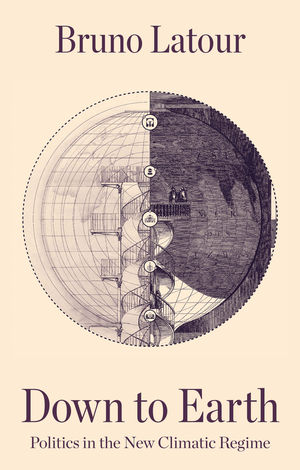
I do find it a valuable but imperfect book. Since I grew up obsessed with pure physics and I now work in ecology, I find really strong support in his frame of thought that de-thrones (astro)physics as the root of all science, and creates a new framework centred on interaction in the Critical Zone (i.e. the troposphere etc) -- in other words, scientific ecology is the fundamental science. He doesn't call it scientific ecology, he describes in various words the study he's hoping for (p93), yet it seems to be exactly that except a little more politically-engaged.
The diagrammatic thinking he uses is a memorable and useful way to argue for a new frame different from the "local-versus-global". It stayed with me from my first reading years ago. There's some confusion in his concepts of "globalisation-plus" and "globalisation-minus" -- although they are key concepts, he omits to define them precisely and so the reader gets a bit stuck (p13 onwards) trying to clarify which terms he's using for which ideas. It does get clarified later (p26? p30?). But it seems to me that Latour, as an eminent senior thinker, suffered here from not having a strict editor.
But then, the book really takes flight, especially in the second half. It ends with a sweet, sweet ode to Europe, which he includes as part of his own contribution to the project of self-description that he says we need. This ode is really beautiful, and touching for a European to read.
Some page-wise notes:
p2 He introduces the (correct) notion that, since the 1980s, the super-rich have decided to conspire against us all, and steal the Earth for themselves. ... and then he writes that what we need is a "map" of "where to land" ... not that we need a fucking revolution?? Why so tame? His readers are not the ones who need to be convinced of the "need to land"! --- How can I "look for a place to land" if powerful forces are determined to steal it from me?
p7 His strong analogy between the victims of empire/landgrabs/globalisation, and our own anxiety at being evicted from a stable future, is indeed a bit tasteless. But nonetheless I must admit it strikes a chord for me.
p46 Ecology has "succeeded" in changing politics "by introducing objects that had not previously belonged to" politics, but also failed because it's so often a marginalised party, and often placed in opposition to "economics" etc, the opposing needs then given greater salience. -- This is the core concern that comes back in his 2023 co-authored booklet: ecology is really about everything, not a fringe interest -- it encompasses economic concerns etc -- so how can we turn that truth into a political reality?
p73 "Nature" is too remote (distant), and also a catch-all term that loses meaning, so don't organise protest around that. --- Fair point he makes. But what "big idea" DOESN'T succumb to that? ... Well, it occurs to me that Extinction Rebellion's ideas are a good example, their very concrete demands (tell the truth, organise citizen's assemblies, etc). Latour expands and fills in his idea of "the terrestrial" in the second half of the book, and I think this is a valuable/handy concept indeed. Is it really robust against this distancing?
Latour then discusses a rather Lovelockian cybernetics of agents. It's not really clear to me why he distances his framing from Lovelock: earlier in the book he mentions Gaia but then unhelpfully remarks it would take too many paragraphs to state why that's not the right concept to work with (!). Here he specifically proposes limiting attention to the Earth's "Critical Zone", and this is essentially how (astro)physics gets dethroned. I think it's a good and clear proposition. Biologists know more than physicists about the critical zone; their knowledge is not provincial.
P.S. This LRB article by Jeremy Harding is a great overview of Latour's environmental thinking, and in particular what's good and what's vague about it.