IBAC 2019 Brighton - bioacoustics research
The 2019 International Biocaoustics Congress (IBAC) was its fiftieth year! And it was a very stimulating conference, held in Brighton and organised by David Reby and a lovely team of co-organisers. Shout out to Eilean Reby who designed a really neat visual identity for the conference, with T-shirt and bags designed for everyone - we had a choice of designs featuring bat, bird, insect, fox...
It was my third IBAC (after IBAC 2015 in Germany and IBAC 2017 in India) and I was very happy to chair a session on advanced computational methods, and to see some great work in there. In this post I'll make notes of other things I saw.
Our QMUL bird group presented their recent work. Lies Zandberg spoke about her great work with Rob Lachlan, as part of our project to understand sound similarity from a birds' point of view. Mahalia Frank presented her studies (her PhD with David Clayton) on the neuroanatomy that might explain what zebra finches can hear while still in the egg.
The most shocking bird news, for me, came from the superb lyrebird. Now, the superb lyrebird is a famously showy Australian songbird - the male does this bizarre-looking dance on top of a little mound he's built. The shocking revelation was in Anastasia Dalziell's talk about her studies on the lyrebird's mimicking song. She showed us evidence that the song incorporates sounds from other bird species' mobbing calls (i.e. what groups of birds do when there are predators about), and further, that this mimicry might have evolved to con the female lyre bird into staying around for some copulation when she may be on the verge of wandering away. It's one possible way that complex mimcry might arise through evolution (antagonistic co-evolution) ...and it's very odd behaviour.
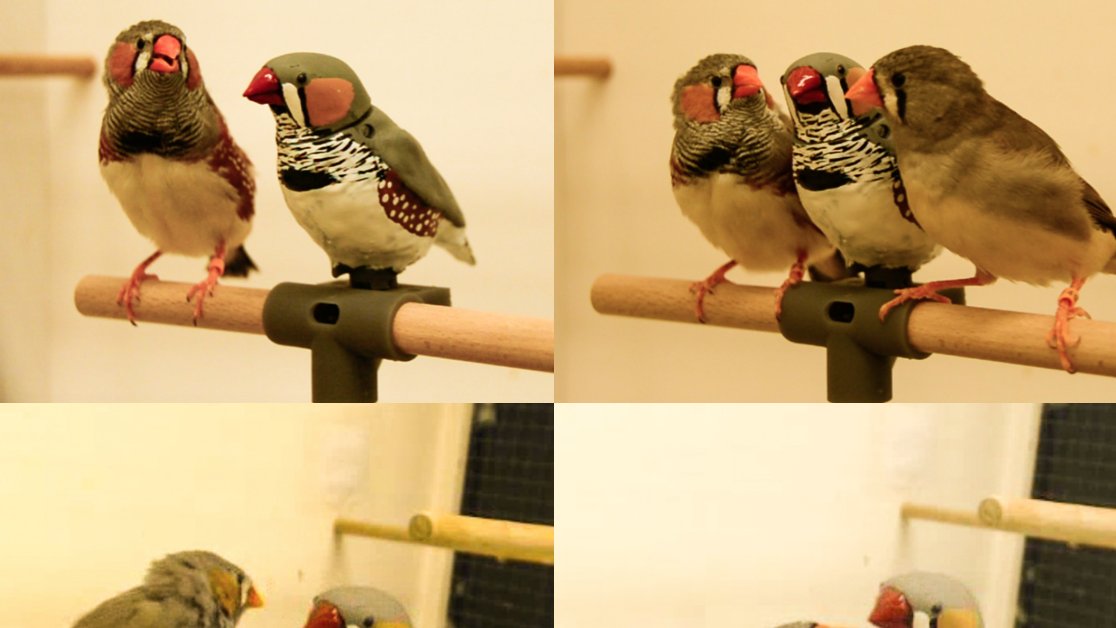
Also making a splash was ... RoboFinch! A very eyecatching piece of work presented by members of Katharina Riebel's lab, as part of a project called "Seeing Voices". Ralph Simon presented about the technical development, and Judith Varkevisser on her vocal learning studies. The idea is to explore how the visual modality affects vocal learning. They tried various things: young birds housed with the tutor, or watching the tutor from the next chamber, or hearing him only; or showing videos of the tutor to the young birds; then a "hologram" (a Pepper's ghost) bird... Then they went as far as building lifesize animatronic zebra finches, with robotic heads/beaks and colours painted to match the exact colour profile of real birds. It seems the young birds really do like to get along with RoboFinch, much more than the other methods, or the traditional audio-only "tape" tutoring.
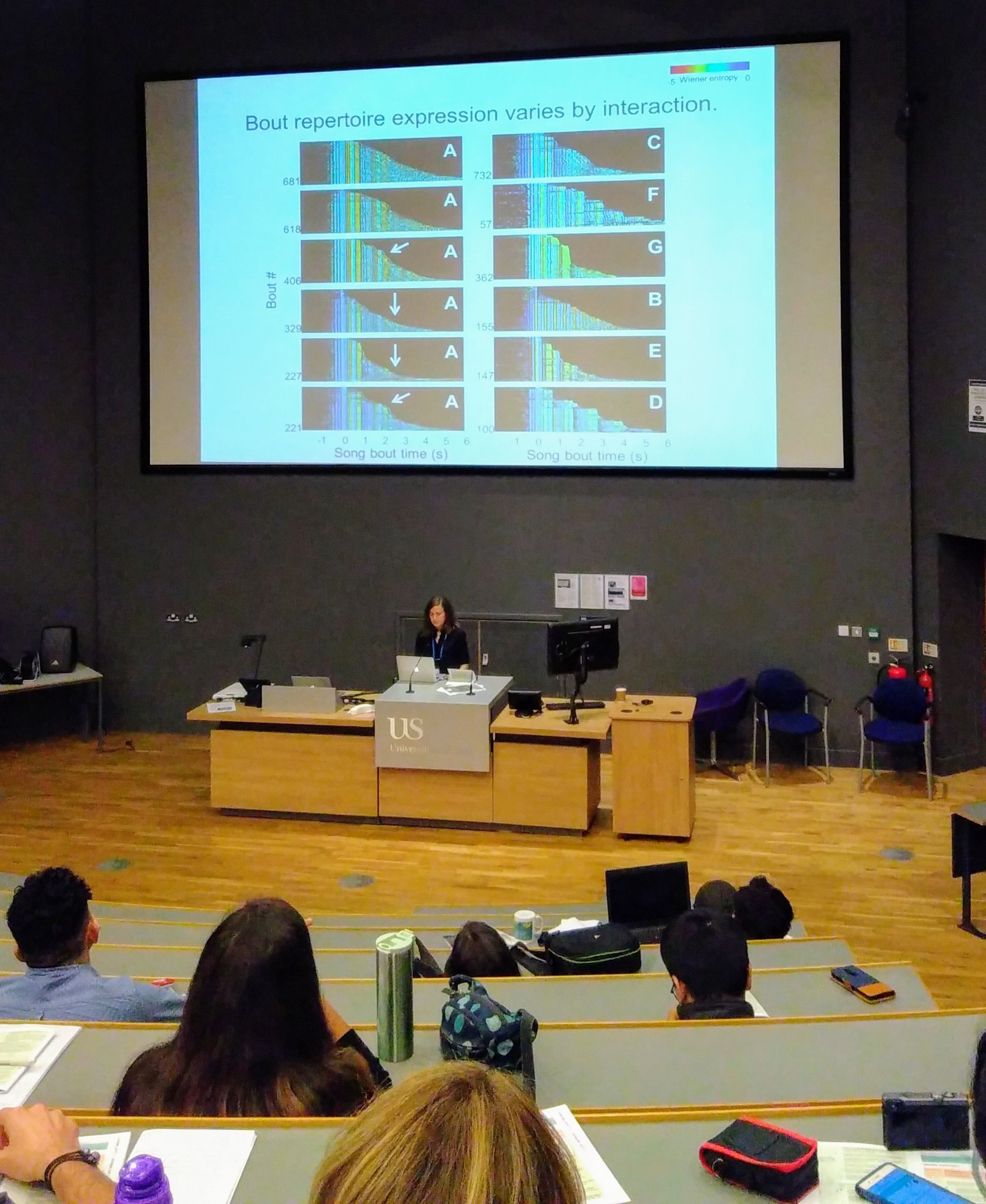
We all like a clever and informative data visualisation technique. A few years ago it was Michael Towsey's "false colour spectrograms" I was excited about - and we saw some use of those at IBAC 2019. A new visualisation was Julia Hyland Bruno's work (part of her PhD with Ofer Tchernikovsky) - surprisingly simple, she renders many different renditions of a zebra finch song as a colourful image in which each row is a colour-mapped time series for one rendition. With a bit of judicious alignment, the effect is to give an immediate visual impression of the repeatability and the structure in the song. A paper showing the technique is here.
I continue to be interested in rhythm and timing in animal and human sounds, and IBAC is a good place to catch some research on this.
- Michelle Spierings presented a very intriguing new method she has been developing with Tecumseh Fitch: a "palimpsest" scramble of words on-screen, while the sound of a repetitive kick drum plays. The question: does the kick drum help you to entrain and spot the words appearing on the beat? The answer: yes. There are some other neat things you can think of trying with this method.
- Isabelle Charrier showed acoustic recognition of northern elephant seal mates used pulse rate (and spectral shape, spectral centroid) were super stable carriers of individual ID. --- Intriguingly, Juliette Linossier (separately) presented her work on indivudal ID in the sound of northern elephant seal pups: the mothers can recognise their pups' sounds, but those pups' sounds are weird-sounding creamy grunts, and it's very hard for us listeners to guess how the individual identity might be represented in there.
- Florencia Noriega showed her quantitative method for comparing rhythm patterns in animal sound sequences. It's based on the well-known inter-onset intervals (IOIs) and she has applied it to frogs, parrots and zebra finches, showing that it makes an apparently discriminative compact representation.
- Nora Carlson showed the very interesting setup she has at the Max Planck Institute of Animal Behaviour - a group of free-flying birds in a large barn, 3D motion-tracked using a Vicon camera system. She's running a study on vocal communication networks - which is of interest to me given that I've analysed smaller vocal networks of birds before. In fact in the paper I just linked to, there's a reanalysis of some of the work Manfred Gahr presented later in the same session - they have some great work studying bird vocal communication via tiny little backpacks that birds carry around. From the same group, Susanne Hoffmann presented their study of duetting weaver birds in the wild - amazing that they're live-recording the audio as well as neural activity of pairs of birds out in the wild.
Good to catch up on large-scale and ecoacoustic monitoring too.
- Sarab Sethi and Becky Heath presented their work on large amounts of acoustic data gathered in Borneo. They used 3G-connected Raspberry-pi based devices. I think Sarab's method of using the off-the-shelf Google "AudioSet features" as an audio representation has many appealing qualities: unsupervised, reproducible, and clearly representing ecoacoustic data in at least a partly-semantically-disengangled fashion. There are some definite residual questions: someone pointed out that since AudioSet is based on human-oriented Youtube audio, it's unlikely to represent high frequency events usefully, and clearly doesn't represent ultransonics at all. It would be a good thing if, as a community, we created a large "EcoAudioSet" and a fixed feature representation derived from it.
- Plenty of projects using AudioMoth as their audio gathering tool. One nice example is Tomas Honaiser Rostirolla's project to document Brazilian ecoacoustics - they made 20274 manual annotations (3988 of which at species level) from 6048 recordings, and openly published I believe. Great.
- Wesley Webb got a lot of attention, not only for his prize-winning presentation of his study on bellbird song in New Zealand, but also for introducing "Koe", a web-based an open-source tool intended to speed up the manual process of labelling large amounts of bioacoustic audio data.
- Paul Roe gave us an overview of their "acoustic observatory" in Australia, and in particular the institutional and collaborative efforts needed to create and maintain such a large monitoring project. For example, the use of piggy-backing on other researchers' projects ("heading out in to the bush? could you check this recorder for us while you're there?")
As usual for IBAC, I learnt some amazing things about bioacoustics outside the realm of birds. Some great bat work represented, e.g. from Sonja Vernes' group (I remember IBAC 2015 when I think she might have been literally the only person talking about bats).
One little observation: both Julie Oswald and Jack Fearey had used a neural net called "ARTwarp" to cluster the vocalisations in their whale data, to try and understand their repertoires. I don't know this method, but it seems to be an unsupervised clustering method incorporating time-warping - might be of interest.
And even more, I continue to learn from the weird world out there beyond the vertebrate animals. Amazing little insects that nibble holes in leaves, for example, so that they can create little acoustic cavities to broadcast well. The most out-there bit of acoustic communication was as follows... a type of ants drilling holes in acacia tree thorns, which then create a whistling signal in the wind, to scare away cattle. Even better, the researchers are currently tested this hypothesis by drilling thousands of little holes in trees in Africa, to see if the reduced whistling affects the cattle behaviour. (This was presented by Kathrin Krausa on behalf of Felix Hager.)
Oh one more thing -- the vocal imitation competition had some fantastic results. As the final event of the entire conference, we listened to a deluge, a menagerie of inexplicable animal sounds that had been imitated by IBAC attendees themselves. This could become a fixture in the calendar...