Research visit to MPIO Seewiesen
I'm nearing the end of a great three-week research visit to the Max-Planck Institute for Ornithology at Seewiesen (Germany). It's a lovely place dedicated to the study of birds. Full of birds and ornithologists:

I'm visiting Manfred Gahr's group. We had some ideas in advance and some of them have turned out nicely fruitful for this brief visit.
With Lisa Gill we've been looking at jackdaw calls. "Where is the individuality encoded?" is a question various researchers have asked about animal sounds. With these jackdaws it's a great challenge to think about in computational (machine listening) terms, because jackdaws (like many corvids) have calls with complicated structure, sometimes creaky, sometimes harmonic, often a mixture. Did you know that songbirds have two sets of vocal folds, whereas humans have one? Well that certainly can make things tricky, if you're trying to use a standard harmonics-based or pitch-based analysis, or... to be honest most methods will trip up here for some reason or other. Not all songbirds use both sets of vocal folds noticeably at the same time but I suspect it's a big part of the complexity here. You also see period-doubling effects and the like - perhaps caused by dual voicing or perhaps by other control. I don't think there's that much known about the physiology/biomechanics of these particular vocalisations, nor the learned/volitional control.
So, together with my student Veronica Morfi, we've applied some signal-processing methods to try and get a clearer view on Lisa's dataset of jackdaw calls. I think we've found some useful little improvements, learnt from each other, and it's been a good topic to have a go at together.
- With Lisa as well as Mauricio Nicolas Adreani and Pietro d' Amelio we've been making use of the method I use for analysing timing influences in zebra finch communication networks. We've got some interesting results with one of Nico's datasets - all preliminary for now, so I'll leave it at that!
- With Albertine Leitão we're having a look at zebra finch song tutoring, since our feature-learning method for bird classification has some properties that could potentially make it attractive for teasing out signatures of tutor influence on song patterns. This one is even more preliminary at the moment.
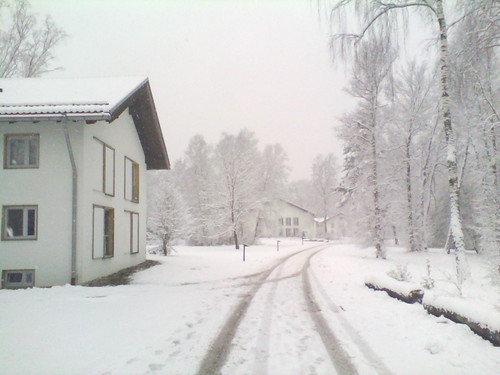
I'm staying on-site, and I've been lucky enough to catch the tail-end of the beautiful snowy weather, making it look like this:
Thanks to my hosts and collaborators for their involvement!