Dan's guide to common birds of Morocco
Morocco has a nice set of birds - fun to encounter, for a European. Easy to get to know them even in the cities. Here's my hit list:
-
Moussier's redstart - This comes top of the list because
(a) it's the national bird of Morocco!
(b) it's endemic to the Atlas mountains - you only find it there!
(c) we saw it foraging around while we stopped at the top of a mountain pass for a glass of mint tea! (The mint tea was for us. I don't know what the bird had.)
(d) I took a classic photo of it. Can you see the Moussier's redstart? With its black-white-black-white upper pattern, and underneath its rust-red belly?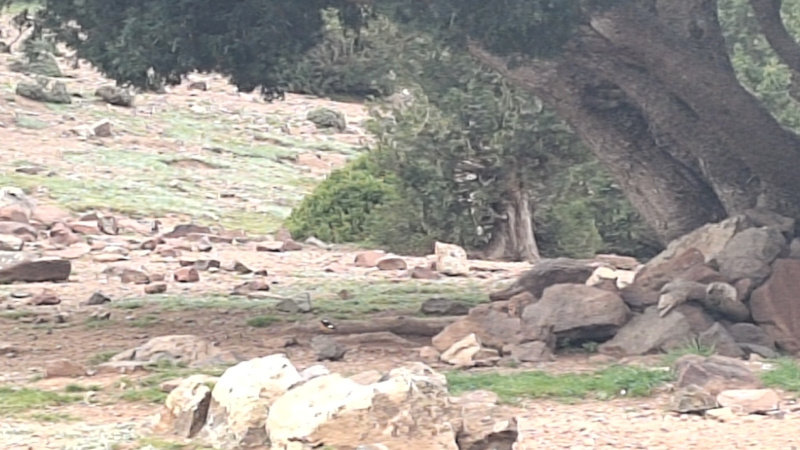
-
Spotless starling. This looks similar to our familiar starling but is pure black instead of iridescent. It sings differently. And it waggles its wings in an endearing way while it sings. ... You have to see it in action.
-
Alpine swift. These high-speed birds I've seen elsewhere, but the novelty is that there are many of them racing around in the city squares of Morocco, nesting in holes in the wall and then racing around flying low and screaming enthusiastically as they race past you in groups diving for insects.
-
House bunting. This little bird is noticeable for its all-grey head and its all-brown body, which really is a different colour-scheme than most birds you'll see around. It's common in north-west Africa and so I guess Morocco is a good plac to see them. We often saw them living/foraging actually inside riads, and elsewhere.
-
Common bulbul. The bulbul I've not seen before, but it's apparently common all across Africa. It was common in cities, with a pale brown topside and a white underside.
-
White stork. The stork is pretty common where I come from but in southern Spain and northern Morocco there were many. What's especially noticeable about storks is their massive nests, which they build right at the top of mobile phone masts or disused mosque minarets, making intriguing architectural intervensions.
A great question about birdsong
There are many mysteries about birdsong, some obvious and some not. This one hadn't occurred to me, but it's a great question:
"Why does a sedge wren with 300-400 different songs take days to reveal them, as if he didn't care whether anybody knew how many songs he was capable of singing?"
(From Nature's Music: The Science of Birdsong, chapter 4.)